

The Legislative Yuan yesterday passed a new law that lays out principles on how artificial intelligence (AI) is to be governed in Taiwan and designated the National Science and Technology Council (NSTC) as the governing authority for AI.
Under the Artificial Intelligence Basic Act (人工智慧基本法), the government is required to promote AI research and applications, while also prioritizing social welfare, digital equity, innovation and national competitiveness.
The act stipulates that AI development should adhere to seven core principles: sustainability and well-being, human autonomy, privacy and data governance, cybersecurity and safety, transparency and explainability, fairness and non-discrimination, and accountability.
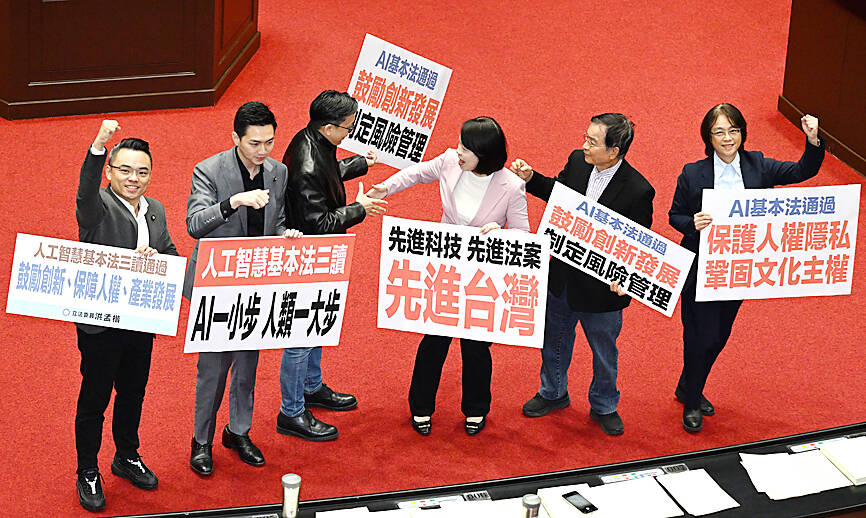
Photo: Liao Chen-huei, Taipei Times
To mitigate risks, the act stipulates that AI applications must not harm people’s lives, freedom or property, nor undermine social order, national security or the environment, or involve bias, discrimination, false advertising, misinformation or fabrication.
Although the act does not have provisions detailing how the principles are to be enforced or carried out, it designated the NSTC as the authority for AI in Taiwan.
The authority provision was adopted with the support of Chinese Nationalist Party (KMT) and Taiwan People’s Party lawmakers over objections of Democratic Progressive Party (DPP) lawmakers.
The DPP objected to the provision, as basic laws traditionally do not specify an authority.
The act also requires the Executive Yuan to establish a national AI strategy committee — chaired by the premier and comprising academics, industry representatives, agency heads and local government leaders — to formulate national AI development guidelines.
The committee must meet at least once a year, with administrative support handled by the NSTC.
Beyond those principles, the new act calls on the government to allocate funding within its fiscal capacity for AI research, applications and infrastructure, and to provide assistance and subsidies for AI development, training, testing and validation.
The act also calls for data openness and personal data protection measures, risk-based AI management that follows international standards, and safeguards for labor rights, including the retraining of workers and employment assistance for those displaced by AI.
link