One of the featured presentations at Nashville AI Week was about a local company called Podcraftr that helps turn written content into audio podcasts. Reporter Nicolle Praino lent her voice to the AI technology which converted her story into a podcast. She was then able to refine the transcript and add additional details for the audio. Praino created The Blueprint podcast to try out the AI audio technology for the story about Nashville AI Week.
Leaders in technology were joined by people across industries last week for two days of programming about artificial intelligence and business during Nashville AI Week.
The event was held at City Winery and hosted by the Enterprise Technology Association (ETA), a national member organization bringing together business and technology experts. The group also partnered with the locally based Innovation Studio. Co-founded by Brian Moyer, Peter Rousos and Tim Estes, the startup incubator launched its first company during Nashville AI week.
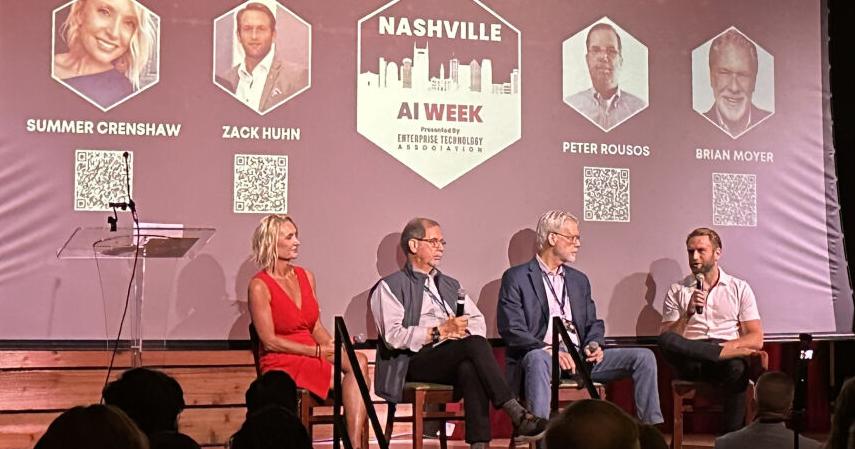
Brian Moyer (center) announces the launch of VendoIQ during a panel with Summer Crenshaw, Peter Rousos and Zack Huhn at the opening of Nashville AI Week.
Photo: Nicolle S. Praino
During one of the opening presentations, Moyer announced the start of operations of VendoIQ, a mobile app that allows field sellers to input CRM updates and other notes via voice, with David Howerton as the CEO.
“It actually launched in January. We held the announcement so that we can do it right here at this event,” Moyer said. “But the why for being involved in this event is — from day one we knew that to be successful, we were going to need to build a community around AI. And so when this opportunity came up, it was just a no brainer.”
Last fall, Moyer attended Cincinnati AI Week, which spurred him to have Innovation Studio partner with the Enterprise Technology Association to bring the event to Nashville. ETA CEO Summer Crenshaw said the group has already planned eight cities this year with AI Weeks.
“Every single city is a representation of what is going on in that market,” Crenshaw said.
“And our goal — and I hope that through the next couple of days you guys feel this — is that you’ll have conversations with people you would never see in another conference. … So our hope is by bringing together things that are typically siloed, or community groups that are typically siloed, we get to be the group that casts the wider net, brings everybody together, and then hopefully we see bigger lift and impact on the cities that we serve.”
On Friday morning, Crenshaw hosted a Women in AI breakfast to kick-off the final day’s programming. She said that in starting creating the AI Week programming, it was important that women in each of the cities also be able able to gather and find their community and support systems.
In all, the two-day event included nearly 40 different presentations or breakout sessions on topics ranging from ethics, governance, incubating companies, state policy and AI developments across industries from blue collar jobs to health care and even retail and fast food.